Steel casing is easy to think of as the pipe that gets left underground after an auger bore is complete.
In reality, steel casing in auger boring is part of the boring system itself.
The casing affects alignment, friction, spoil removal, steering, and how accurately the bore progresses. Its wall thickness, roundness, manufacturing method, and overall quality can all influence the job.
Kyler Woody of Atlas Group describes casing as the “gun barrel” of an auger bore. If the barrel is not straight, you cannot expect the shot to stay straight either.
That is why casing should be discussed before it is ordered, not after it arrives on the jobsite.
Steel Casing Is Part of the Bore From the Beginning
During an auger bore, the steel casing is installed as the bore advances.
The auger and cutting head operate through the inside of the casing. As the head cuts through the ground, excavated material travels back through the casing.
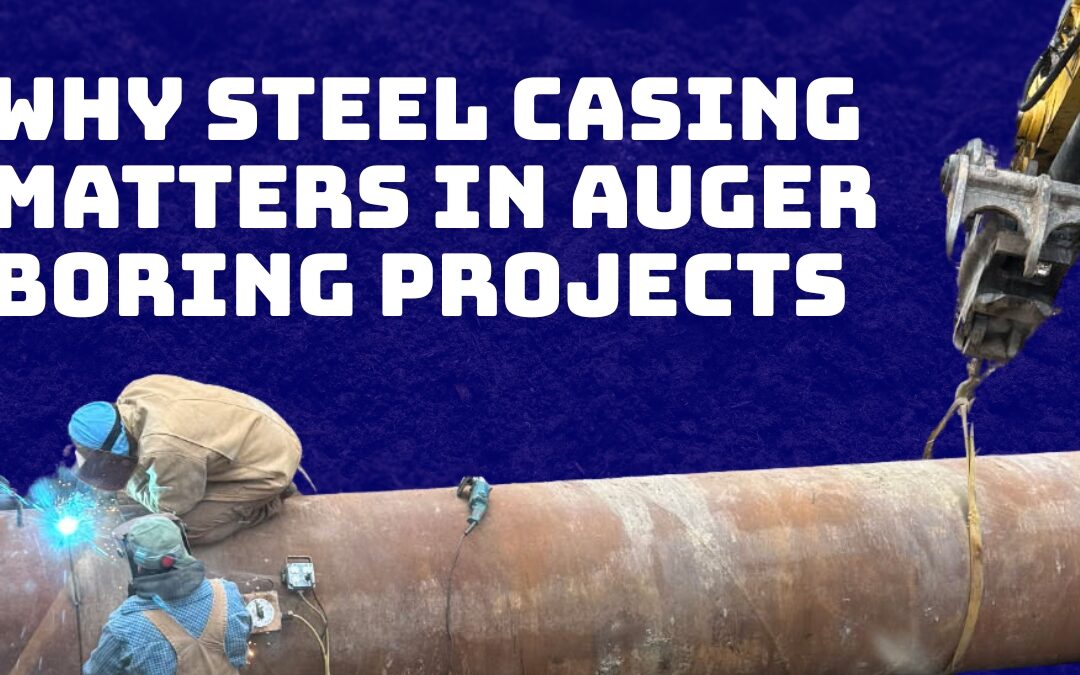
The crew may install the casing in sections, commonly around 20 feet at a time. Each new section is welded to the previous section before the machine continues pushing forward.
Because the casing progresses with the bore, it does much more than protect the final utility.
It helps define the path.
If the casing remains straight, round, and properly aligned, the crew has a better foundation for controlling the bore.
If the casing is distorted or inconsistent, the entire operation becomes more difficult.
Roundness Matters More Than It May Appear
A steel pipe may look fine from a distance and still create problems for an auger boring crew.
Atlas Group pays close attention to whether the casing is actually round.
Woody described an example involving 36-inch casing where individual sections varied dramatically in inside diameter. Some measured approximately 34.5 inches while others reached around 38 inches.
Those pieces could not simply be welded together and expected to perform correctly.
A casing section that becomes oval is sometimes described as “egged.”
That creates several problems.
First, crews may be trying to weld a round section to an oval section.
Second, the auger needs consistent space inside the casing to move material efficiently.
Third, the outside of the casing may no longer create a consistent cut through the surrounding ground.
All of those issues can affect bore performance.
Manufacturing Method Can Affect Casing Performance
Not all steel casing is manufactured the same way.
Atlas Group prefers casing that maintains a consistent, round shape. Woody specifically discussed the difference between seam-welded and spiral-welded casing.
With seam-welded casing, a flat sheet of steel is formed into a cylinder and welded along a straight seam.
Spiral-welded casing is formed differently, with the steel wrapping around the pipe in a spiral pattern.
Atlas Group has found that spiral-welded casing can create challenges in auger boring because it may be more likely to become irregular or “egged.”
That does not mean spiral casing has no useful applications.
However, auger boring places specific demands on the casing.
The augers need a predictable interior. The casing sections need to align. The outside diameter also needs to remain consistent enough for the cutting system to work as intended.
Casing Shape Can Affect Friction
Auger boring already requires significant thrust to move casing through the ground.
Anything that increases resistance can make the bore more difficult.
The cutting head may use wing cutters that extend slightly beyond the casing. These cutters create a small amount of clearance around the pipe.
If the casing is round, that clearance can remain relatively consistent.
If the casing is egg-shaped, the situation changes.
One portion may have adequate clearance while another portion presses directly against untouched ground.
That creates additional friction.
Atlas Group explained that this uneven contact can also influence the direction of the casing. If the ground is softer on one side, the casing may begin moving toward that area.
A small inconsistency in casing shape can therefore become a much larger issue as the bore progresses.
Wall Thickness Affects Deflection
Casing wall thickness is another important factor.
Steel pipe can flex.
The thinner the wall, the more potential there may be for the casing to deflect or bend under certain conditions.
That becomes especially important when crews are trying to maintain tight line and grade requirements.
Atlas Group often recommends heavier wall casing when the project allows it, particularly with smaller diameters.
Woody used 12-inch casing as an example. A client may assume that smaller casing can be thinner and lighter because the pipe itself is smaller.
Atlas Group often prefers the opposite approach.
A heavier wall can help the casing resist bending and bowing as it is pushed through the ground.
The correct wall thickness still depends on the project. However, it should be considered as part of the boring strategy rather than treated only as a material specification.
Smaller Casing Can Be Harder to Control
Larger casing may seem like the more difficult installation.
Atlas Group says that is not always true.
Smaller-diameter casing can actually remove some of the crew’s options.
On larger casing, crews may be able to enter the pipe and inspect conditions directly. They can also make certain adjustments from inside the casing.
Atlas Group discussed crews entering larger casing to make corrections such as jacking a shoe or completing other work needed to bring the bore back toward the intended line.
That is not possible on very small casing.
As Woody explained, casing below roughly 24 inches can be more difficult because the crew loses the ability to physically enter the pipe and inspect or correct certain conditions.
The smaller casing may still be guided with control heads, water levels, or other tools.
However, the crew has fewer options once the bore begins moving away from the desired path.
That makes casing quality even more important.
Straight Casing Helps With Line and Grade
One of auger boring’s major strengths is its ability to maintain accurate line and grade.
That accuracy begins with proper setup, but casing also plays a major role.
As each section is installed, the crew watches how the next piece lines up.
Atlas Group explained that if the casing begins diving downward, the back end may start rising. That difference becomes noticeable when the next section is positioned for welding.
The same principle applies to left and right movement.
An experienced operator can recognize these changes early.
However, poor casing can complicate that judgment.
If sections are bent, out of round, or inconsistent, the crew may have difficulty determining whether the alignment problem is coming from the ground, the cutting head, or the casing itself.
Good casing removes one of those variables.
Casing Should Be Discussed Before It Is Purchased
On many projects, the client purchases the steel casing.
Project specifications may also determine whether the steel must meet domestic sourcing requirements or other standards.
Atlas Group can provide casing when requested. However, Woody explained that it is often more cost-effective for the client to purchase the material directly.
The important step is involving the boring contractor before that purchase happens.
Atlas Group can help recommend:
- Appropriate wall thickness
- Casing type
- Diameter
- Manufacturing style
- Supplier considerations
- Project-specific tolerances
That conversation can help prevent a shipment of casing from arriving onsite only to create problems for the boring crew.
Cheap or Rejected Casing Can Become an Expensive Problem
Atlas Group has seen what happens when casing is selected without considering the bore.
On one project, a client supplied spiral-welded casing. The Atlas Group operators immediately began checking wall thickness, diameter, and roundness because they knew the material could create problems.
Measurements showed major variation between individual pieces.
The crew later learned that the casing had been rejected material that someone believed would still be suitable for installation under a roadway.
From outside the industry, that decision may seem reasonable.
The steel is going underground. Why should a small difference matter?
For an auger boring crew, those differences can affect welding, friction, alignment, spoil removal, and the ability to control the bore.
Saving money on casing can become expensive very quickly if the material creates problems underground.
Steel Casing in Auger Boring Is More Than a Finished Product
The casing is not simply something that remains in the ground after the machine leaves.
It is part of how the bore is created.
A successful steel casing auger bore depends on casing that supports the tooling, maintains alignment, resists unnecessary deflection, and provides a consistent path for spoil removal.
Before material is ordered, project teams should consider:
- Is the casing consistently round?
- What manufacturing method was used?
- Is the wall thickness appropriate?
- How much deflection could occur?
- How tight are the line and grade tolerances?
- Can crews enter the casing if corrections are needed?
- Does the selected casing work with the planned auger system?
Atlas Group performs auger boring throughout West Virginia, Ohio, Pennsylvania, Kentucky, Virginia, and surrounding areas.
For the Atlas Group team, casing selection is part of project planning because the quality of the casing can directly affect the quality of the bore.
It may eventually become the pipe left underground, but during construction, it is one of the most important tools on the project.